Learning Outcomes
i. Identify and explain the principle of complete dominance in inheritance.
ii. Define key genetic terms: dominant, recessive, phenotype, genotype, homozygous, heterozygous.
iii. Illustrate and interpret genetic crosses involving dominant and recessive alleles.
iv. Describe the significance of the P1, F1, and F2 generations in genetic studies.
i. Complete Dominance
Complete dominance occurs when a dominant allele completely masks the effect of a recessive allele in the phenotype of the heterozygous genotype. In such cases, the presence of one dominant allele is enough to exhibit the dominant trait.
ii. Key Genetic Terms
Dominant: An allele that expresses its phenotypic effect even when heterozygous with a recessive allele. It is represented by a capital letter (e.g., A).
Recessive: An allele that only expresses its phenotypic effect when homozygous. In the presence of a dominant allele, the trait it codes for is not seen in the phenotype. It is represented by a lowercase letter (e.g., a).
Phenotype: The observable characteristics or traits of an organism, such as flower color, which are the result of the interaction of the genotype with the environment.
Genotype: The genetic makeup of an organism; the combination of alleles for a given trait (e.g., AA, Aa, aa).
Homozygous: An organism with two identical alleles for a trait (e.g., AA or aa).
Heterozygous: An organism with two different alleles for a trait (e.g., Aa).
iii. Genetic Crosses
Genetic crosses involve mating two individuals and analyzing their offspring to understand how traits are inherited. The parental generation is known as P1. When individuals from the P1 generation are crossed, they produce the first filial generation, or F1. Crossing individuals from the F1 generation yields the second filial generation, or F2.
In a typical monohybrid cross involving complete dominance, a homozygous dominant individual (AA) is crossed with a homozygous recessive individual (aa), producing offspring (F1) all with the heterozygous genotype (Aa). These F1 individuals will all display the dominant phenotype because A is the dominant allele.
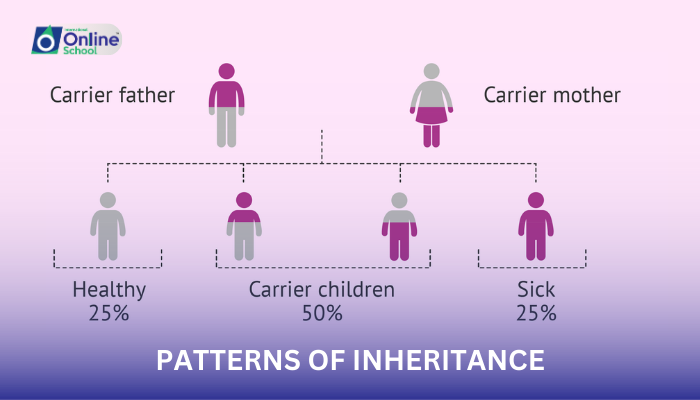
When F1 individuals are crossed (Aa x Aa), the F2 generation displays a phenotypic ratio of 3:1, where three-quarters of the offspring show the dominant phenotype and one-quarter show the recessive phenotype. The genotypic ratio is 1:2:1, one homozygous dominant (AA), two heterozygous (Aa), and one homozygous recessive (aa).
Significance of Generations in Genetic Studies
The use of P1, F1, and F2 generations is significant in genetic studies as it helps to reveal patterns of inheritance, such as complete dominance. By analyzing the outcomes of crosses over these generations, geneticists can deduce the modes of inheritance, predict genetic ratios, and determine whether a trait is due to a dominant or recessive allele.
In conclusion, understanding the concept of complete dominance and the roles of different alleles is essential for interpreting genetic crosses and studying patterns of inheritance. The study of successive generations (P1, F1, F2) allows for the observation of how traits are passed on and expressed in organisms.
